XR training, explained in plain words
XR, or extended reality, is the umbrella for three ways to train with simulated content, mostly in a headset. They differ in one thing: how much of the real world you can still see.
The three kinds of XR
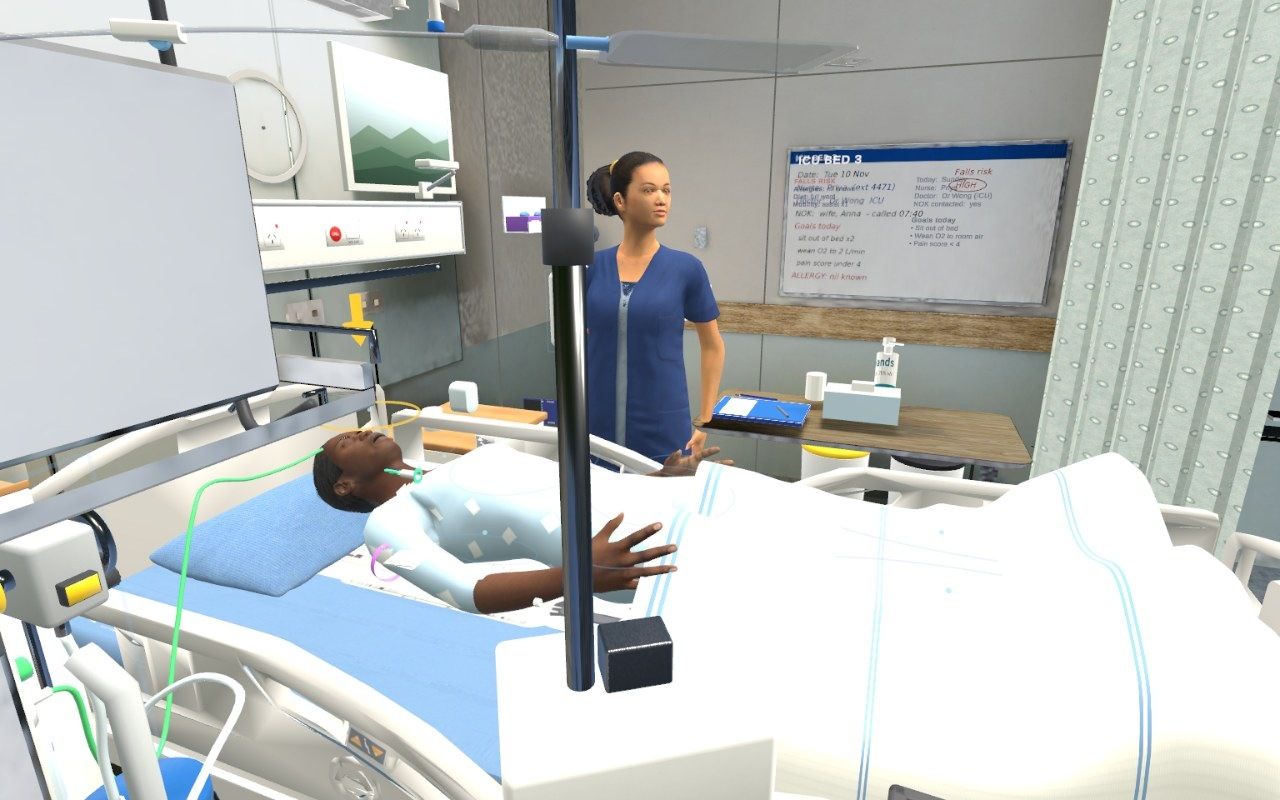
VR
Virtual reality
The headset replaces the world with a simulated one.
Virtual reality training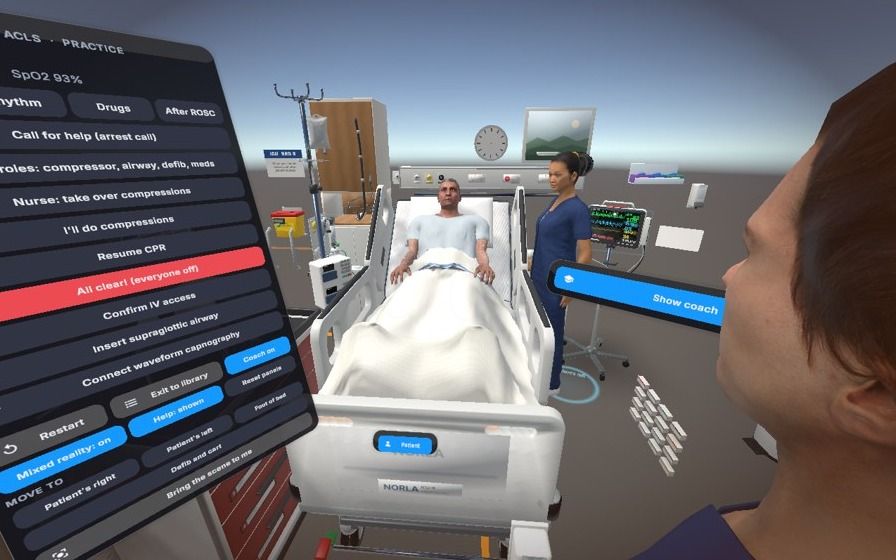
MR
Mixed reality
Cameras show your real room, and the simulation is placed in it.
Mixed reality training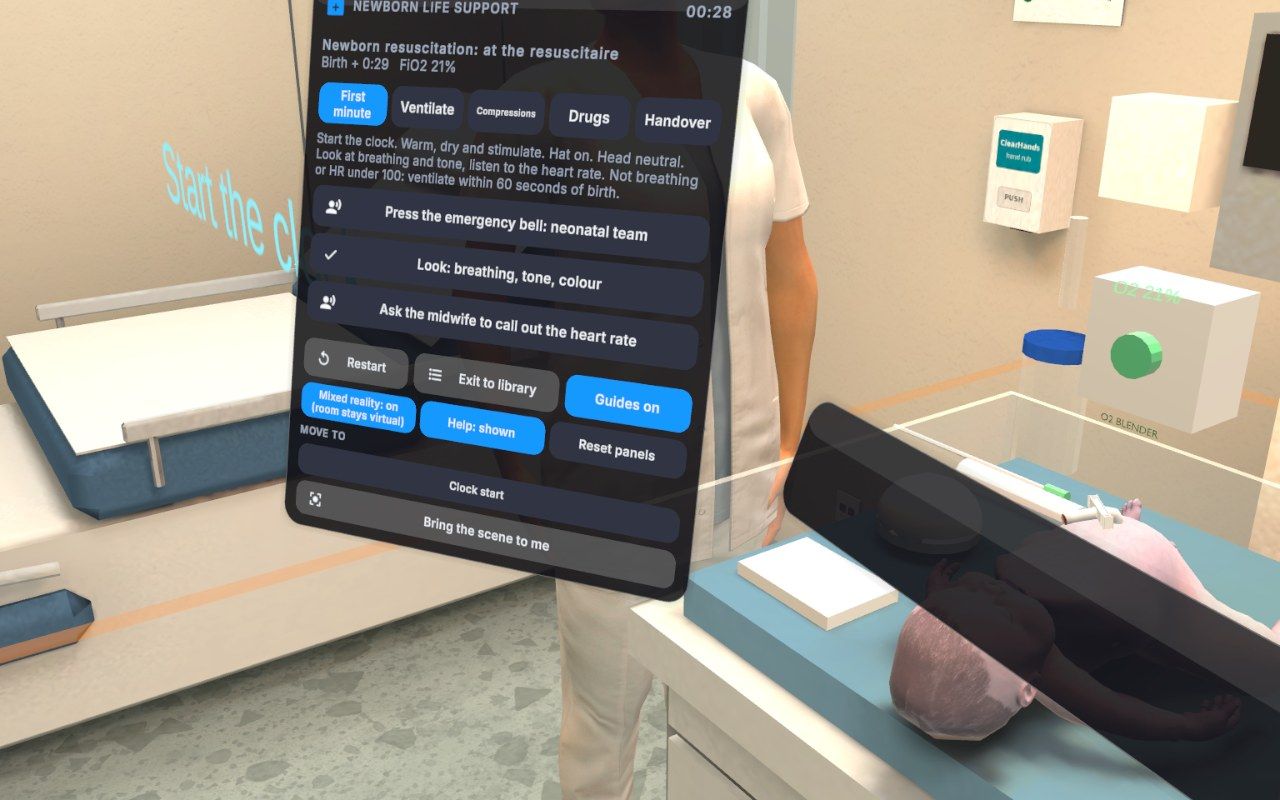
AR
Augmented reality
Digital content appears in the real world: as holograms through a clear visor, or on a phone screen.
Augmented reality training


Product captures. Real passthrough and HoloLens views will replace the MR and AR images.
VR vs mixed reality vs AR
| VR | Mixed reality | AR | |
|---|---|---|---|
| What you see | Only the simulation | Your real room, through cameras, plus the simulation | The real world through clear glass, plus holograms |
| Example headsets | Compatible with Meta Quest 3, PICO 4 Ultra Enterprise and PC VR | Meta Quest 3 or PICO 4 Ultra Enterprise (passthrough) | Microsoft HoloLens 2 (existing fleets), or a phone or tablet (web AR) |
| Space needed | A clear area, about 2 × 2 m | Your room as it is, with a clear area | Your room as it is, with a clear area |
| Strongest for | Places you cannot use or visit: a ward at 3 am, a confined space, a patrol base | Rehearsing in your own space and seeing your team | Overlays in a real room, for sites that already own HoloLens |
| On a phone or tablet? | No | No, it needs a headset | Yes: web AR in the browser, no app, for single items at real size |
| What we offer | Available | Available | HoloLens 2: supported for existing fleets. Phone and tablet web AR: custom build, on request |
Swipe the table sideways to see all three.
One Meta Quest 3 does both VR and mixed reality. The same scenario runs in either mode.
Phone AR vs headset mixed reality
| Phone or tablet web AR | Headset mixed reality | |
|---|---|---|
| In short | Look at and place single items at real size, from a link. One hand holds the phone. | Do the whole scenario with both hands, with a patient who reacts, scoring and debrief. |
| What we offer | Custom build, on request | Available on Meta Quest 3 |
3DoF or 6DoF?
Whichever kind of XR you choose, check the degrees of freedom. All the headsets we support are 6DoF.
Which should you use for what?
Start from what you want trainees to do. The technology follows.
Practise a rare emergency until the sequence is automatic
VRPut trainees somewhere you cannot take them: a mine, an EV workshop, a patrol base
VRRehearse in the ward bay or sim lab your team actually uses
Mixed realityRun a team scenario where people can see each other’s faces
Mixed realityAdd a changing face and monitor to your existing manikin
Mixed reality (coming)Use the HoloLens 2 headsets you already own
ARShow equipment at real size on people’s own phones, before a course or on site
Phone AR (custom build)
A note for UK readers
In the UK, XR is the term you will most often see in health and care education, including in NHS training discussions. If you are writing a business case, the comparison above uses the same terms.
We are an Australian company and do not currently work with the NHS. Our scenarios follow ANZCOR or AHA guidance through regional packs. A UK pack is not available.
Go deeper
- VR training
Room-scale, interactive simulation on standalone headsets.
- Mixed reality training
Passthrough on Meta Quest 3: the scenario in your own room.
- AR training
In the real room on HoloLens 2 and Meta Quest 3, plus phone web AR built to order.
- VR in healthcare
Clinical VR simulation for nursing, hospitals and aged care.
Need something built for you? See custom VR training development and AR and mixed reality development.
XR training questions
What does XR stand for?
Extended reality. It is the umbrella term for virtual reality (VR), augmented reality (AR) and mixed reality (MR).
What is XR training?
Any training delivered through VR, AR or mixed reality. The common thread is that the trainee acts in a three-dimensional space rather than reading or watching.
Is XR the same as VR?
No. VR is one kind of XR. XR also covers AR and mixed reality, where the real world stays in view.
Which is best for healthcare training?
It depends on the job. VR suits rare emergencies and places you cannot use for training. Mixed reality suits rehearsal in your own space. Many teams use both, on the same headset.
Do you work with the NHS?
We are an Australian company and do not currently have NHS customers. We are happy to talk to UK teams about a pilot.
See it in a headset
Book a 30-minute demo. We will run a scenario live, talk through your training units and scope a pilot that fits your team.
